Folding Tables and Fortune: The Unlikely Business School Running Every Sunday Morning
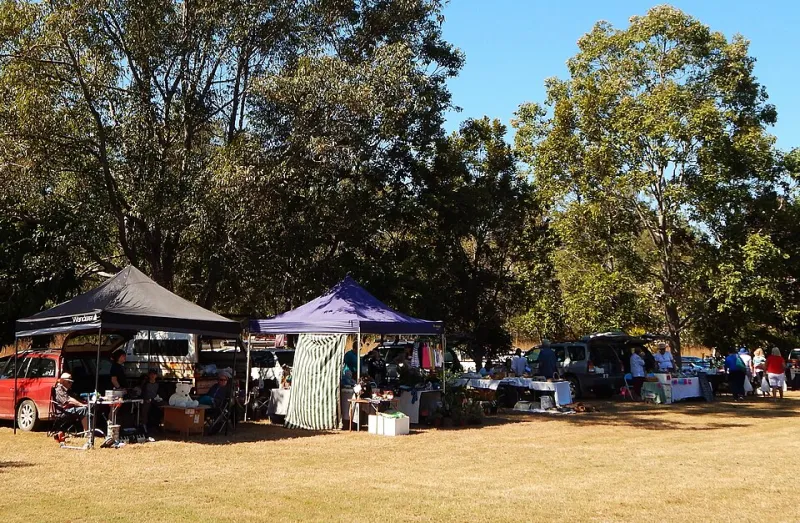
Photo: RegionalQueenslander, CC BY-SA 4.0, via Wikimedia Commons
Every Sunday morning, before most of the country has put the kettle on, thousands of makeshift entrepreneurs up and down Britain are setting up shop. A folding table from Argos, a few garden-clearance bin bags, a flask of tea and — if they're savvy — a float of pound coins. By lunchtime, many of them will have shifted more stock than some online shops manage in a month.
We spend a lot of time on this site talking about marketing on a shoestring. But if you really want a masterclass in doing more with less, skip the business books and head to your nearest car boot sale. Bring a fiver for parking and a notebook.
Location Is Everything — Even When It's a Muddy Field
Watch an experienced booter set up and you'll notice they don't just plonk their table anywhere. They scout the entrance routes. They know that people walk a loop, and the first table with eye-catching stock catches the impulse buyers before wallets have closed for the day.
Your online shop works the same way. Where do customers 'walk past'? Your homepage hero, your first Instagram grid post, the subject line of your email. That's your pitch by the gate. Don't bury your best offer three clicks deep any more than a trader would bury the vintage denim under a pile of tea towels.
The Display Sells Before You Do
There's a reason the sharpest sellers bring a clothes rail rather than a bin bag. A rail says 'browse me'. A bag says 'rummage at your own risk, and I'll haggle you down to nothing'.
The lesson translates directly. Presentation signals price. A £4 candle photographed on a cleared kitchen table with decent daylight looks like a £14 candle. The same candle snapped on a messy worktop looks like it should come with a free multipack of batteries. You don't need a studio — you need a wall, a window, and ten minutes of tidying.
The Art of the Haggle Is Really the Art of Anchoring
Here's where the car boot MBA gets properly interesting. Watch a good trader and you'll see they never open with their lowest price. The £3 item becomes £2.50, then two for £4. The buyer walks away feeling like they won; the seller still made their margin.
Small businesses constantly give the game away by discounting first and hardest. Flip the script:
- Open higher, with room to move. Your 'sale' price should always feel like a concession, not a default.
- Bundle instead of cutting. Two-for offers protect your per-item price while shifting more stock — exactly how the woman with the jigsaw puzzle stall clears everything by noon.
- Know your walk-away number. Traders do the maths on the petrol and the pitch fee before they arrive. You should know your floor before the first customer asks 'what's your best price?'
Read the Crowd, Not the Textbook
The best booters adjust in real time. Toys out when families arrive, tools forward when the trade buyers do their early-morning sweep at 6am. They're not following a content calendar — they're responding to what's in front of them.
Your equivalent? Check when your audience actually shops. If your analytics say Sunday evenings are your peak, stop posting your best offers on a Tuesday afternoon because a marketing guide told you to. The trader with the PowerPoint cables out at half seven in the morning isn't being clever on paper — they're being clever in practice.
The Exit Strategy: Never Leave With Stock
By mid-afternoon, watch the endgame. Prices drop, 'everything a pound' signs appear, and the goal shifts from margin to going home light. It's not panic — it's planning. Stock in the loft is money in a hole.
Small businesses hoard dying stock out of pride. Seasonal lines lingering in February, last year's packaging taking up the spare room. A clearance email with an honest subject line — 'Help us clear the shelves' — often outperforms polished campaigns, because it's human. And humans, it turns out, buy from humans.
The Cheapest Business Education in Britain
Total cost of this MBA: pitch fee, roughly £10–£20. Thermos of tea, optional but recommended. What you'll learn about pricing psychology, display, timing and closing a deal is worth more than most courses charging four figures.
Go along. Watch. Take notes. Then ask yourself one question on the drive home: if my business had to survive on a folding table this Sunday, what would I change first?
Chances are, the answer isn't 'spend more money'.